


 About Us
 الشروط
 الخصوصية
 Community Guidelines
Africa Cannot Rise While It Bleeds From Within
A revised Zoomer Africa political analysis on conflict, resources, and the unfinished struggle for African unity
By Zoomer African History
Africa’s deepest tragedy is not poverty. It is disunity in the middle of abundance. This continent holds vast reserves of gold, cobalt, copper, oil, gas, fertile land, water, and youthful energy, yet too much of that wealth still sits beside war, displacement, and underdevelopment. The African Union’s own vision under Agenda 2063 is clear: an integrated, prosperous, and peaceful Africa, driven by its own citizens. The logic of the AfCFTA is equally clear: African countries should trade more with one another, build regional value chains, and turn shared geography into shared prosperity. Yet the continent still loses too much strength through internal conflict, fractured politics, and economies that export raw wealth while importing dependency.
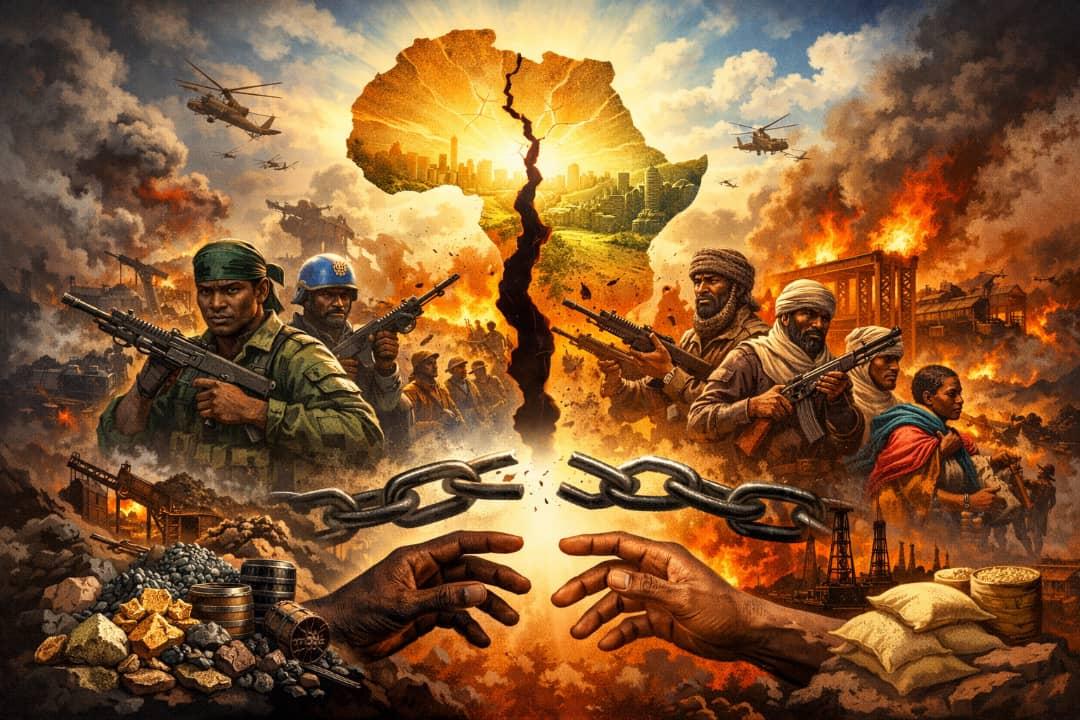
This is why the crises in eastern Democratic Republic of Congo, Sudan, South Sudan, and the wider Sahel must be read together, not as isolated fires but as warnings from one continent. Their histories differ, their actors differ, and their immediate triggers differ. But they all expose the same painful weakness: Africa still struggles to organize power around common development instead of competitive control. In some cases, resources are the direct prize. In others, they are part of the war economy that keeps violence alive. In all cases, the result is the same: Africans spend energy fighting for possession of wealth that could have been used to build roads, power grids, industries, schools, hospitals, and a stronger continental future. That is the political scandal of modern Africa. It is not only that Africa is rich and unstable; it is that it remains too often divided against itself while others continue to benefit from that division.
Eastern Congo remains one of the clearest examples of this contradiction. The conflict there is rooted in a long history of state weakness, armed movements, regional mistrust, and foreign interference, but the mineral question cannot be ignored. In 2025, the UN Security Council called on Rwanda’s defence forces to cease support for M23 and withdraw from DRC territory, while later UN reporting said M23 remained in control of large parts of North and South Kivu with support from the Rwanda Defence Force. This is not a small detail. Eastern Congo is home to some of the world’s most strategic minerals, and when armed groups entrench themselves in such areas, conflict becomes tied not only to identity and security but also to taxation, supply chains, smuggling routes, and global demand. A land blessed with resources becomes a battlefield because the political control of wealth is treated as more valuable than the peaceful sharing of prosperity.
Sudan shows a different version of the same African wound. Its war is fundamentally a struggle for state power between the Sudanese Armed Forces and the RSF, but the economics of violence matter. Chatham House’s 2025 analysis states that competition over gold assets was one of the drivers of the conflict and that the gold trade now helps sustain the war and its wider network of armed and regional actors. When a country’s most valuable resources are absorbed into military rivalry, they stop being national assets and become instruments of destruction. Gold that should finance reconstruction instead feeds armed competition. Wealth that should build institutions instead corrodes them. Sudan’s crisis is therefore not only a Sudanese failure. It is also a wider African lesson in what happens when resource governance collapses into war governance.
South Sudan, too, carries the burden of unrealized independence. It won nationhood with enormous hope, yet state fragility, elite mistrust, and overdependence on oil have kept peace vulnerable. The World Bank has warned that the shutdown of the Dar Blend pipeline through conflict-affected Sudan severely undermined South Sudan’s macroeconomic stability, while Reuters reported in February 2026 that the UN human rights chief said the country was at a “dangerous point” as killings surged and the fragile peace agreement came under renewed strain. This is what happens when a young nation is built on a narrow economic base without strong institutions to manage its political transitions. Oil should have financed national consolidation. Instead, instability in both Sudan and South Sudan has turned that same dependence into a source of vulnerability.
In the Sahel, the picture is more contested and must be written with fairness. Supporters of Ibrahim Traoré in Burkina Faso, and of the wider military-led alignment in Burkina Faso, Mali, and Niger, do not accept every international accusation against their governments as neutral fact. Many see such claims as part of a broader campaign to weaken leaders who have openly rejected old Western influence and what they describe as neo-colonial pressure. That sentiment is not imaginary; large public rallies in support of Traoré have taken place, and the wider sovereignty message of the Alliance of Sahel States has resonated with many citizens who feel that earlier political arrangements failed to protect them from insecurity, humiliation, or foreign dependency. At the same time, the region remains under severe insurgent pressure, and rights groups as well as major media have continued to report grave concerns about civilian deaths and democratic backsliding. The strongest political reading, then, is not to reduce the Sahel to a single foreign narrative or a single revolutionary slogan. It is to recognize that the Sahel has become the arena of a larger African argument: who gets to define security, sovereignty, legitimacy, and development in post-colonial Africa.
This is where the debate becomes bigger than any one war. If African states continue to fight over who controls mines, oil fields, customs routes, grazing corridors, and security networks, then the continent will remain politically fragmented even while speaking the language of Pan-Africanism. But if African governments begin to treat their resources as the foundation of shared industrial policy, shared infrastructure, and shared bargaining power, then the story can change. The problem is not that Africa lacks the means to rise. The problem is that too often its political systems reward capture more than cooperation. That is why minerals leave Africa in raw form, why value is added elsewhere, and why conflict zones repeatedly become entry points for external influence. Africa is not losing only lives in these wars. It is losing time, bargaining power, and the future value of its own resources.
A better path is neither romantic nor impossible. Africa must make peace an economic program, not only a diplomatic phrase. It must process more of its minerals at home, connect markets through rail, roads, and power pools, protect civilians with stronger institutions, and ensure that strategic resources serve African value chains before feeding foreign dependency or armed patronage. Regional blocs must become more than ceremonial bodies; they must act early, mediate firmly, and defend both sovereignty and accountability. The dream of African unity will remain hollow if it does not produce material outcomes that ordinary people can see: jobs, energy, food security, mobility, trade, and dignity. Agenda 2063 already provides the philosophical map. What is missing is the discipline to place continental development above narrow political possession.
The final truth is uncomfortable but necessary. Africa is not poor in resources; it is too often poor in collective political purpose. Congo, Sudan, South Sudan, Burkina Faso, Mali, and Niger each reveal a different face of the same struggle: the battle between fragmentation and union. If Africa’s wealth continues to be governed through guns, rival factions, and external manipulation, then the continent will remain rich on paper and weak in practice. But if Africans decide that no mineral is more valuable than peace, no regime interest is greater than continental progress, and no border dispute is worth the permanent sabotage of African development, then a different future is still possible. Africa does not need to conquer another continent. It needs to stop bleeding itself. Only then can its resources become the foundation not of war, but of a truly independent and united African century.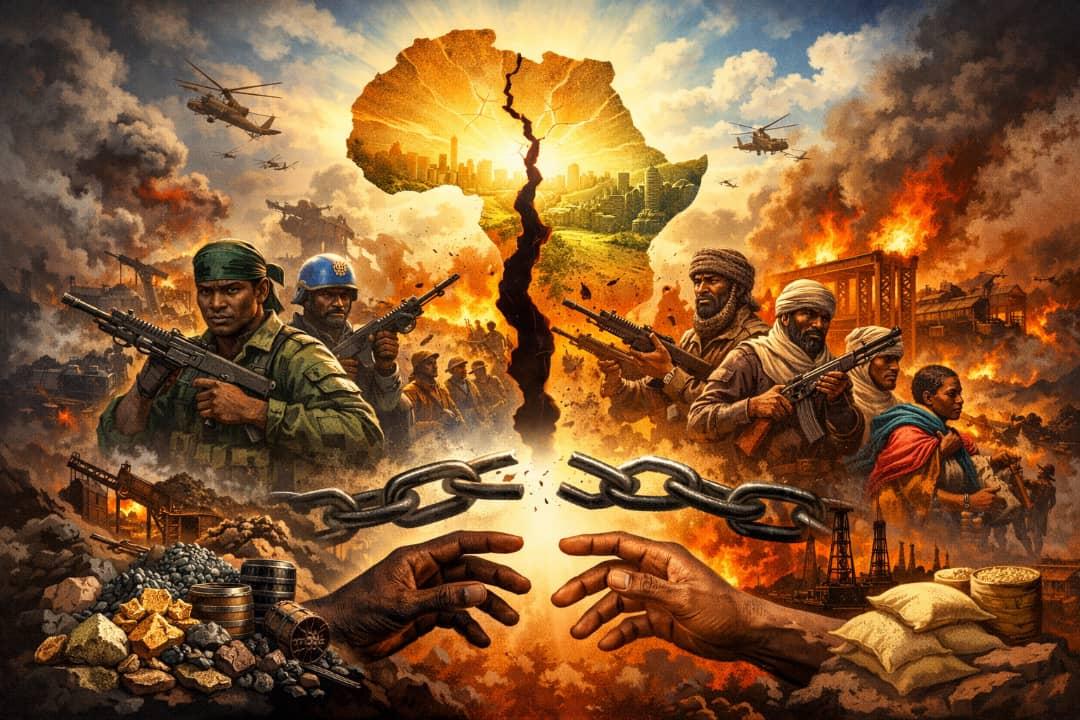
Image illustrating the conflicts in Africa, some graphics may not be suitable to readers for more information read zoomer terms of use
The writer is historian at African hub and theologian at Harvard University


 English
 French
