


 About Us
 Terms
Terms
 Privacy
 Community Guidelines
Alur Kingdom Issues Pronouncements on Wetland Conservation
By Mike Rwothomio
The Alur Kingdom has issued a series of pronouncements urging its subjects in Uganda and the Democratic Republic of Congo to immediately halt the depletion and degradation of wetlands.
The Kingdom reaffirms its full support for the Government’s wetland conservation policies and sustainable environmental management, expressing concerns over continued wetland degradation practices, such as pollution, unsustainable farming methods, deforestation, charcoal burning and other destructive activities by many subjects, which contravene national environmental policy and threaten critical ecosystem services.
In a message from His Royal Majesty Phillip Olarker Rauni III, delivered by Kingdom Prime Minister Prince Lawrence Opar Angala during the burial of the late Ritah Fualing in Okuru Pamach Parish, Atyak Sub-County, Zombo District on 23rd April 2026, the Kingdom emphasized the urgent need for community-led wetland management, integration of indigenous traditional knowledge into environmental planning, and comprehensive public education on sustainable wetland use.
“His Majesty Ubimu has come out with a pronouncement on wetlands because it is one of the most valuable ecosystem on our planet, so Ubimu says our traditional knowledge system should help us to responsibly farm, fish and manage water and live in harmony with our environment,” Ubimu said in his series of pronouncements read by the Kingdom Prime Minister (Jadipu) Prince Lawrence Opar Angala.
The King’s message about wetland conservation moves along settling land and other civil disputes through Alternative Dispute Resolution (ADR) mechanisms such as mediation and negotiations instead of rushing to courts of law.
According to the national status report on the status of wetlands in Uganda, in the past 25 years at regional level, Eastern region faces highest rate of wetland degradation of 46%, followed by central region with 29%, western 28% and northern Uganda with 21%.
The King reminded the subjects about the environmental conservation benefits saying “we should take the conservation of our environment very important, our natural environment in the Kingdom including DR Congo are facing pollution, unplanned development, and sustainable use”, highlighting the benefits of multi-stakeholders concerted effort in conservation of the environment.
Speaking to mourners, Major General Dick Olum highlighted the revered position and the role of the Kingdom, urging the community to pay allegiance and respect the Kingdom and its activities and directives.
The Alur Kingdom’s powerful pronouncement aligns with government continuous efforts through all fronts to address the high rate of wetland degradation.
Environmental experts have largely attributed the rapid wetland degradation across the regions of the country to rapid population growth, conversion of wetlands for development processes of urbanization and low enforcement of existing laws and wetland policies at regional levels.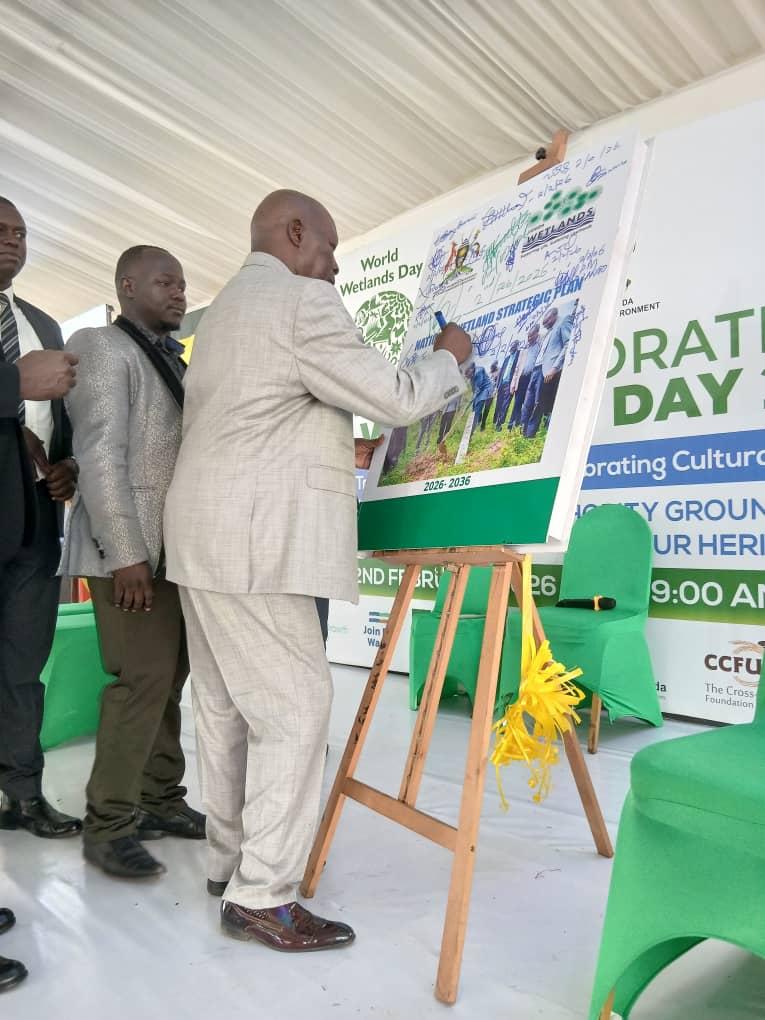
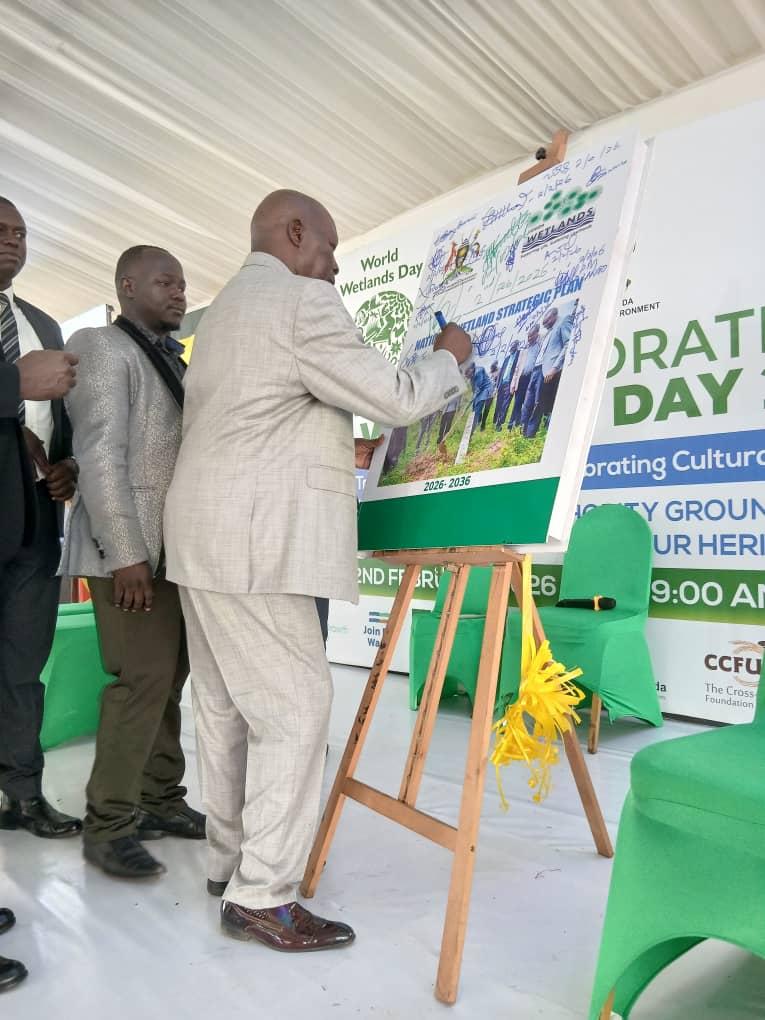
Prime Minister of Alur Kingdom Prince Lawrence Opar Angala signs a wetland conservation pledge during world wetland day 2026 celebration in Kampala.
President Museveni has recently directed all wetland encroachers to vacate peacefully, declaring an amnesty while enforcing strict protection for Uganda’s 8,613 wetlands. The directive prohibits farming especially rice and building in wetlands, encouraging alternative livelihoods like fish farming on the periphery. The initiative aims to restore coverage from 9.3% to 11% by 2036.
Daniel Pikisa, the executive director of Colein Aid, a non-governmental organization in Zombo said in an interview that they are supporting wetland conservation through their “Access to land justice” project which is focusing on planting trees along River Ora to mitigate climate injustice and rampant depletion and degradation along river Ora, through planting of native tree species.
“We are planting native tree species along River Ora buffer zone as alternative to divert their attention from the degradation activities,” Pikisa said.
The Assistant Resident District Commissioner of Zombo, Bruno Mananu, commended the Kingdom for such a restoration effort, calling for “concerted multi-stakeholder efforts to restore and conserve wetlands” for their vital ecological functions and services.
In his firm stance against wetland degradation, President Yoweri Kaguta Museveni in February this year during the commemoration of World Environment Day called on all Ugandans to take lead in preserving wetlands for posterity as Uganda joined the rest of the world to mark World Wetlands Day.
Represented by Prime Minister Rt. Hon. Nabbanja Robinah who launched the National Wetland Strategic Plan during the World Wetlands Day celebrations at Bugolobi in Kampala recently, the President emphasized that for generations, wetlands had shaped the people’s customs, beliefs and ways of life.
In 1994 the wetland cover stood at 15 percent but this has been declining to 8.9 percent by 2024.However, the government intensified efforts to reclaim the degraded wetlands and by 2025, Uganda’s wetlands cover recovered from 8.9 percent to now 9.3 percent.
Museveni recognized the role traditional leaders play in preserving the ecosystem and called upon all Ugandans to take lead in preserving the wetlands, noting the NRM government remained committed to the conservation, sustainable use and management of wetlands commending Development Partners, Cultural institutions, the private sector, academia, civil society organizations and the local communities without whom the conservation of wetlands would have been an uphill task.
The government this year unveiled the National Wetland Strategic Plan 2026–2036, reinforcing the government’s commitment to protecting wetlands amid threats from encroachment, degradation, and climate change.
Under Uganda’s National Environment Act 2019 and the National Environment Regulations, reclaiming, draining, or damaging wetlands is strictly prohibited. Offenders face severe penalties, including fines up to UGX 600 million, imprisonment of up to 12 years, or both, plus possible community conservation obligations.
This year’s World Wetlands Day was marked under the Theme “Wetlands and traditional knowledge: celebrating cultural heritage” where Cultural and traditional leaders were asked by the government to involve them in wetland conservation efforts because they are directly linked to the people who destroy these wetlands.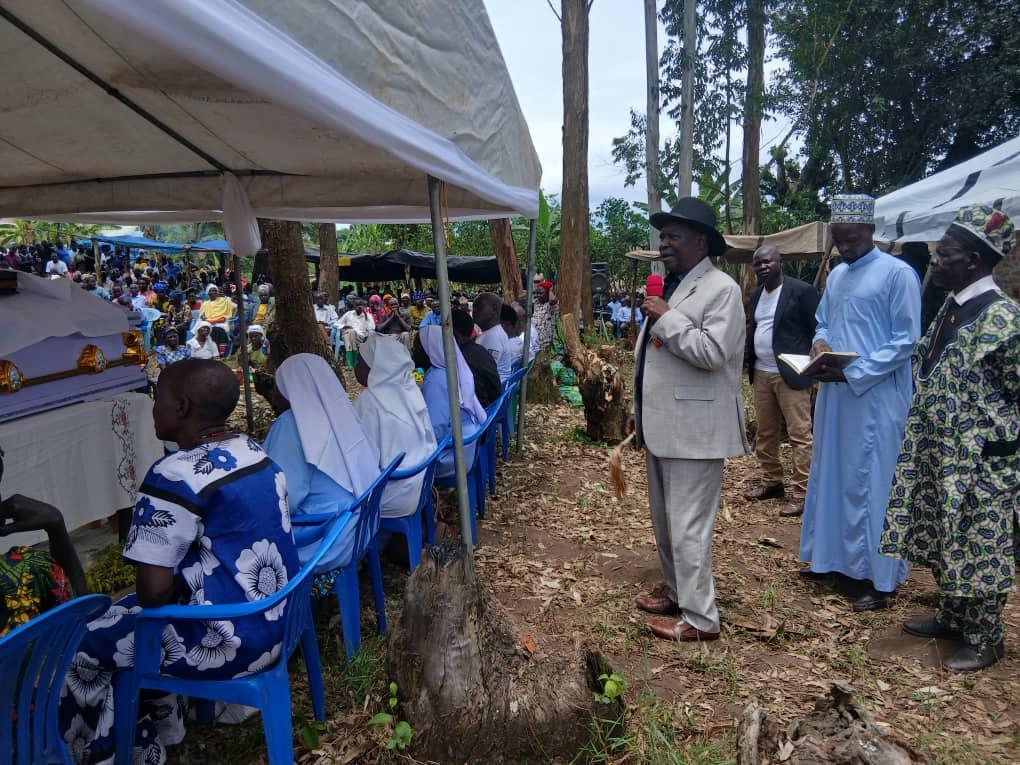
Jadipu Prince Lawrence Opar Angala addresses reads the pronouncements whilst addressing Mourners on Thursday.
Mike Rwothomio is news editor at zoomer Africa, your number one grassroot information hub

 English
 Arabic
 French
