


 About Us
 الشروط
 الخصوصية
 Community Guidelines
The Coup of 27 July 1985: Tito Okello Lutwa Takes Power in Uganda
By Zoomer Editorial
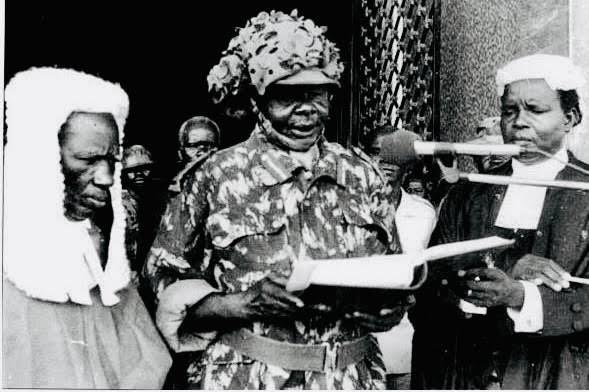
On 27 July 1985, Uganda experienced a significant turning point in its turbulent political history when General Tito Okello Lutwa seized power through a military coup. This event marked the fall of President Milton Obote’s second regime and ushered in a brief but impactful period of military rule that lasted until January 1986.
Background: A Nation in Crisis
Uganda in the early 1980s was plagued by political instability, economic collapse, and civil unrest. After returning to power in 1980 through a controversial election, President Milton Obote (Obote II regime) faced growing dissent from both the civilian population and the military. The government was accused of human rights abuses, economic mismanagement, and failing to unite a deeply divided nation.
At the same time, armed rebel groups, the most notable being Yoweri Museveni’s National Resistance Army (NRA), waged an increasingly effective guerrilla war against the central government. This insurgency, known as the Bush War or Luwero War, had severely weakened Obote’s hold on the country, especially in the central regions.
The Coup of 27 July 1985
On the morning of 27 July 1985, troops loyal to General Tito Okello Lutwa, the army chief of staff and a veteran of Uganda’s post-independence military, overthrew Obote in a bloodless coup. Okello, an ethnic Acholi like Obote, led the coup with the support of his deputy, General Bazilio Olara-Okello (no relation), who was then the commander of the Uganda National Liberation Army (UNLA).
The coup was staged primarily in the capital, Kampala, with limited resistance. Obote fled into exile in Zambia, and the new military government declared its intention to restore peace and order.
Tito Okello's Brief Rule
General Tito Okello became President of Uganda, forming a Military Council to govern. His regime promised a transitional government, peace talks, and national reconciliation. One of the major aims was to negotiate with Museveni’s NRA, but the talks—held in Nairobi under Kenyan mediation—ultimately failed.
Despite initial hopes, Okello's government struggled with legitimacy, lacked effective control over large parts of the country, and continued to face a powerful and determined rebel force.
The Fall of Okello and Rise of Museveni
The failure of the Nairobi peace talks and continued military pressure led to the rapid unraveling of Okello’s regime. On 26 January 1986, just six months after the coup, Yoweri Museveni’s NRA captured Kampala, and Tito Okello fled into exile in Tanzania.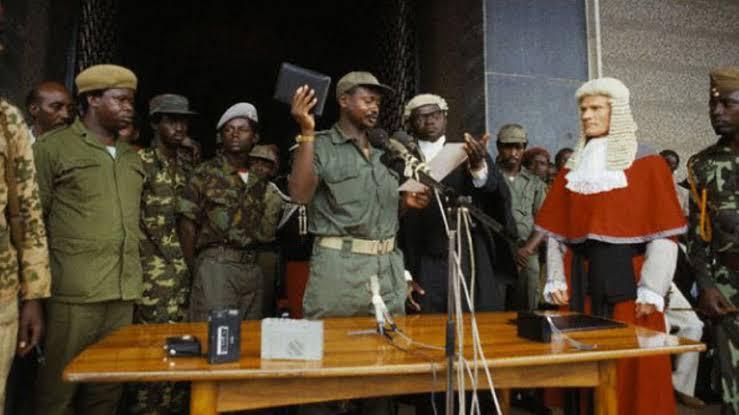
Yoweri Kaguta Museveni being swon in as the next president of Uganda
Museveni became president and ushered in a new era in Ugandan politics—one that continues to shape the country today.
Legacy of the 1985 Coup
The 27 July 1985 coup is remembered as the final military overthrow in a series of coups and counter-coups that had destabilized Uganda since the 1960s. It represented the military’s continued interference in governance but also highlighted the deep fractures within the army itself, particularly between northern and southern ethnic groups.
Though Tito Okello’s rule was short-lived, it paved the way for the emergence of Museveni’s long-standing administration. Okello returned to Uganda in 1993 after a peace agreement and was later granted a state funeral upon his death in 1996.
The events of 27 July 1985 were a pivotal moment in Ugandan history, marking the end of one regime and setting the stage for the rise of another. The coup by Tito Okello was both a symptom and a cause of Uganda's instability—but also a transitional phase that ultimately led to a more enduring political order under Museveni.
Zoomer Africa is Africa's Gen z social media platform connecting and Uniting Africa, Join the movement Sign Up Now!!



 English
 French
