


 About Us
 Conditions générale de vente
 Confidentialité
 Community Guidelines
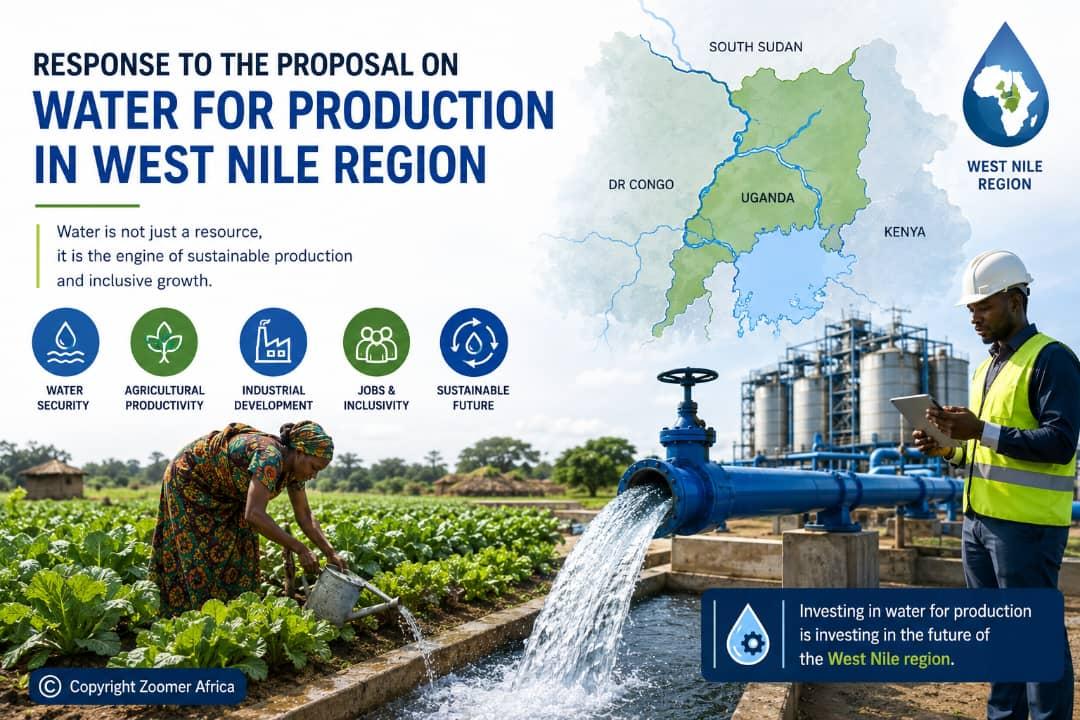
Response to the Proposal on Water for Production in West Nile
By Oringi Denis | Zoomer
The proposal to support West Nile with water for production through the construction of reservoir dams on River Ora, River Kochi, and River Enyau, alongside solar irrigation schemes and valley dams for commercial farmers, is a good and strategic idea.
Water for production is critical for commercial agriculture, livestock farming, food security, and climate resilience.
However, before placing fresh requests before President Yoweri Kaguta Museveni, it is important that we first pause and honestly evaluate ourselves as a region.
We must ask difficult but necessary questions regarding the many irrigation and water projects that have already been implemented in West Nile over the years.
In Pakwach District, formerly part of Nebbi, the Ministry of Water and Environment constructed the Andibo Valley Dam to address severe water scarcity affecting livestock farmers and surrounding communities.
The question today is: how is this dam benefiting the local people? Is it fully functional? Are the surrounding communities utilizing it effectively for agriculture and livestock production?
Similarly, the multi-billion Wadelai Irrigation Scheme in Pakwach District was established to transform nearly 1,000 hectares of underutilized land and support over 3,000 farmers through year-round farming of crops such as rice, maize, and vegetables.
What happened to this project? How many farmers are benefiting today? Has it achieved its intended purpose of transforming livelihoods?
In Yumbe District, the Kingdom of the Netherlands invested heavily in solar irrigation schemes implemented through organizations such as Oxfam, Mercy Corps, and CARE International. Although these were donor-supported projects, they were intended to improve household incomes and commercial farming among the people. The question remains: how effectively did we utilize these projects to transform our communities?
FAO and DanChurchAid also implemented several solar irrigation projects in Adjumani, Obongi, and Moyo districts. Were these projects properly managed? Did the intended beneficiaries truly gain from them? Or did they become another example of projects launched with excitement but abandoned after implementation?
During the 11th Parliament, the Deputy Chairperson of the Committee on Natural Resources came from West Nile. How effectively was that strategic position utilized to lobby for stronger irrigation investments, proper monitoring, and sustainable implementation of water projects in the region?
The National Solar Water Irrigation Project implemented by the Ministry of Water and Environment and constructed by Nexus Green established several irrigation sites in Moyo and Yumbe. How are communities utilizing these sites today? Are the projects operational, productive, and benefiting ordinary farmers?
In 2024, under the Local Climate Adaptive Living (LoCAL) initiative, government and development partners established another water dam project at Got Tar in Ossi East Parish, Parombo Sub-county, Nebbi District at a cost of UGX 314 million. What is the current status of this project? Has it started benefiting the surrounding communities?
Similarly, on February 2nd, the Ministry of Local Government with funding from the United Nations Capital Development Fund (UNCDF) earmarked UGX 371 million for another dam project in Kucwiny Sub-county at Jupala in Nebbi District. Before demanding additional funding from the President, can we first track the implementation progress of these ongoing projects?
The major concern therefore is not only about requesting more projects. The real issue is accountability, sustainability, monitoring, and community ownership of the projects already implemented.
Related Article: Government urged to integrate skilled west Nile farmers as Dutch-funded projects ends.
Who are the real beneficiaries of these projects rolled out to support farmers in West Nile?
- Are ordinary farmers benefiting?
- Are youth groups benefiting?
- Are women farmers benefiting?
- Are cooperatives functioning?
- Are local leaders conducting monitoring?
- Are technocrats ensuring value for money?
- Are communities maintaining these facilities?
West Nile cannot continue demanding new interventions without first accounting for the many billions already invested in agriculture, irrigation, water for production, and climate resilience programs.
The challenge facing the region appears to be deeper:
- Weak supervision
- Poor maintenance culture
- Limited accountability
- Political interference
- Elite capture of projects
- Lack of community ownership
- Inadequate follow-up after project commissioning
Before asking the President for more dams and irrigation schemes, West Nile leaders and stakeholders must first provide accountability on the existing projects and demonstrate how future interventions will be protected from mismanagement and abandonment.
Development is not only about receiving projects; it is about sustaining, monitoring, and ensuring that projects genuinely transform the lives of ordinary people.
By Oringi Denis –Journalist 0701482304, Edited by Zoomer Uganda, Zoomer Africa your number one grassroot information hub for African stories trends and updates


 English
 Arabic
